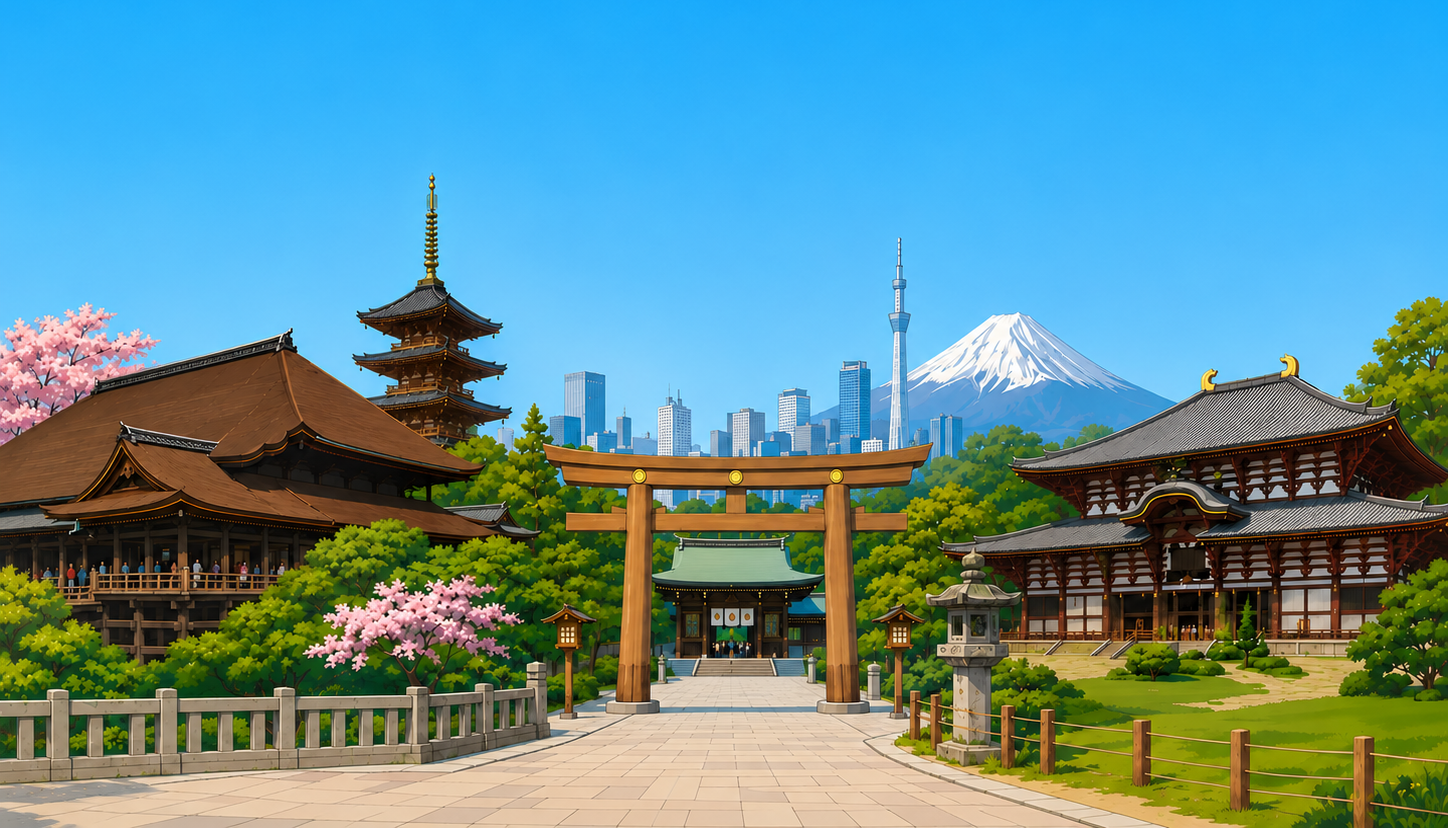
Japan's Living Heritage
Japan is a country where the ancient and the modern coexist in remarkable harmony. Walking through its cities, you'll find centuries-old temples standing peacefully beside gleaming skyscrapers, and traditional wooden houses nestled in the shadows of contemporary architecture. For international students and professionals, this unique blend offers not just tourist attractions, but windows into a civilization that has carefully preserved its heritage while embracing the future.
Kyoto's Temple Legacy
Kyoto, once the imperial capital of Japan for over a thousand years, is home to more than 2,000 temples and shrines. Walking through the Kinkaku-ji (Golden Pavilion), with its top two floors completely covered in gold leaf reflecting off the surrounding pond, is like stepping into a living painting. The experience transcends mere sightseeing—it's a lesson in Japanese aesthetics, the concept of wabi-sabi (finding beauty in imperfection), and the meticulous attention to detail that characterizes Japanese culture.
.png&w=3840&q=75)
The Fushimi Inari Shrine, with its thousands of vermillion torii gates creating tunnels up the mountain, tells stories of faith, devotion, and community that have sustained Japanese society for centuries. For students learning about Japanese culture, these aren't just historical sites—they're classrooms without walls, teaching the principles of Shintoism, Buddhism, and the syncretic spiritual practices that define Japanese religious life.
.png&w=3840&q=75)
Tokyo's Meiji Shrine: Urban Sanctuary
In the heart of bustling Tokyo lies Meiji Shrine, a testament to Japan's ability to create sacred spaces within modern chaos. Surrounded by a forest of 100,000 trees, donated from regions across Japan, the shrine honors Emperor Meiji and Empress Shoken, who presided over Japan's transformation into a modern nation during the Meiji Restoration.
.png&w=3840&q=75)
What makes Meiji Shrine particularly fascinating for international visitors is witnessing traditional Shinto weddings on weekends, where couples in elaborate traditional attire proceed through the grounds in ceremonial processions. It's a powerful reminder that these traditions aren't museum pieces—they're living practices that continue to shape contemporary Japanese life.
.png&w=3840&q=75)
Nara's Sacred Deer and Ancient Temples
Nara, Japan's first permanent capital, offers one of the country's most unique cultural experiences. At Todai-ji Temple, you'll encounter the largest bronze Buddha statue in Japan, housed in the world's largest wooden building. But equally memorable are the hundreds of sacred deer that roam freely through Nara Park, considered messengers of the gods in Shinto belief.
.png&w=3840&q=75)
For students of Japanese culture, Nara represents the roots of Japanese civilization—the moment when Buddhism, imported from China and Korea, merged with native Shinto beliefs to create something distinctly Japanese. The temple architecture, the art, and even the city layout reflect the cultural exchange that has always been part of Japan's story.
.png&w=3840&q=75)
UNESCO World Heritage Sites: Treasures of Humanity
Japan boasts 25 UNESCO World Heritage Sites, each telling a crucial chapter in the nation's story.
Historic Monuments of Ancient Kyoto: Seventeen temples, shrines, and castles in Kyoto and nearby cities collectively form one UNESCO site, representing the pinnacle of Japanese religious architecture and garden design from the 10th to 19th centuries. Ryoan-ji Temple's rock garden, perhaps the most famous Zen garden in the world, consists of just 15 rocks arranged on white gravel—yet it has inspired contemplation and philosophical discussion for over 500 years. These sites offer international students invaluable insights into Japanese aesthetics, philosophy, and the concept of ma (negative space)—principles that influence everything from modern Japanese design to business practices.
.png&w=3840&q=75)
Hiroshima Peace Memorial (Genbaku Dome): The skeletal remains of the Atomic Bomb Dome stand as a powerful symbol of both the horrors of war and humanity's capacity for peace and reconciliation. The Hiroshima Peace Memorial Park and Museum provide a sobering, educational experience that has shaped Japan's post-war identity as a nation committed to peace. For students, especially those interested in international relations, peace studies, or modern history, Hiroshima offers profound lessons about resilience, reconstruction, and the importance of remembering history to prevent its repetition.
.png&w=3840&q=75)
Himeji Castle: The White Heron: Himeji Castle, nicknamed "White Heron Castle" for its brilliant white exterior and elegant appearance, is Japan's finest surviving example of feudal castle architecture. Unlike many Japanese castles that were destroyed in wars or fires and later rebuilt in concrete, Himeji's original wooden structure has survived earthquakes, wars, and time itself. Exploring its defensive design—with maze-like passages, hidden gates, and strategic lookout points—offers insights into Japan's feudal era and the samurai culture that has so captivated global imagination. The castle also demonstrates Japanese engineering ingenuity, having survived the 1995 Great Hanshin earthquake thanks to its flexible wooden construction.
.png&w=3840&q=75)
Traditional Architecture: The Beauty of Wood and Harmony
Japanese traditional architecture reflects a profound philosophy: buildings should exist in harmony with nature, not dominate it. The extensive use of wood, sliding doors (fusuma and shoji), tatami mat flooring, and the integration of interior and exterior spaces all embody this principle.
Wooden Temples and Craftsmanship: Japanese temple carpentry is an art form that has been passed down through generations. Many temples were built without a single nail, using intricate joinery techniques that allow the wooden structures to flex during earthquakes—a brilliant adaptation to Japan's seismic reality. For students of architecture, engineering, or design, studying these structures reveals sustainable building practices and biomimetic design principles that are surprisingly relevant to contemporary environmental challenges.
.png&w=3840&q=75)
Traditional Houses: Lessons in Living: Traditional Japanese houses (minka) offer insights into a lifestyle designed around limited space, changing seasons, and communal living. Features like the genkan (entryway where shoes are removed), the engawa (veranda between interior and garden), and the multi-purpose rooms separated by sliding doors all reflect cultural values about cleanliness, connection to nature, and spatial efficiency. Understanding these concepts helps international students appreciate why modern Japanese apartments are designed the way they are, and offers practical insights for adapting to life in Japan.
.png&w=3840&q=75)
Historical Districts: Time Travelers' Destinations
Gion, Kyoto: The Geisha District: Gion's preserved wooden machiya (townhouses) line narrow lanes lit by traditional lanterns, creating an atmosphere that transports visitors to Edo-period Japan. This is one of the few remaining districts where you might spot a geiko (Kyoto's term for geisha) or maiko (apprentice geiko) hurrying to an appointment in full traditional dress. Beyond the romantic imagery, Gion represents the continuation of traditional Japanese arts—tea ceremony, traditional dance, shamisen music, and the art of conversation. For students interested in Japanese culture, attending a cultural performance in Gion or even participating in a tea ceremony offers experiential learning that no textbook can provide.
.png&w=3840&q=75)
Asakusa, Tokyo: Old Edo Charm: Asakusa, Tokyo's old-town district, centers around Senso-ji, Tokyo's oldest temple. Nakamise Shopping Street, leading to the temple, has been serving pilgrims and visitors for centuries with traditional snacks, crafts, and souvenirs. What makes Asakusa particularly valuable for students is its authenticity combined with accessibility. Unlike some preserved historical areas that feel like open-air museums, Asakusa remains a living neighborhood where traditions continue in the context of contemporary urban life. The annual Sanja Matsuri festival, one of Tokyo's largest, demonstrates how historical districts keep traditional celebrations alive.
.png&w=3840&q=75)
Why This Matters for Students
Understanding Japan's cultural and historical attractions isn't just about tourism—it's essential preparation for living, studying, and working in Japan. These sites embody values that continue to shape Japanese society: respect for tradition, attention to detail, harmony with nature, and the importance of preserving heritage while embracing progress.
"At the Japan Study Center, we prepare students not just to visit these attractions, but to understand and appreciate the deeper cultural currents they represent. Through our Japanese language courses, cultural studies programs, and pre-departure orientation, we ensure that when you encounter these magnificent sites, you'll experience them not as an outsider looking in, but as an informed participant in Japan's ongoing cultural story."