Employment & Careers in Japan
Your comprehensive guide to full-time career pathways, part-time regulations, and internship options in Japan.
"We would like to hire talented personnel regardless of nationality."
"We need personnel who can speak foreign languages and understand foreign situations."
"We would like to actively hire personnel with diverse backgrounds."
In Japan, there are a growing number of companies that operate in line with these statements, and the hiring of international students is increasing. However, it is not easy for an international student to be hired in Japan. Use the detailed statistics and schedules below to plan your career pathway effectively.
Employment Environment in Japan
Job Market for Recent Graduates
The job market that recent graduates of universities and colleges enter when they first start working is called the "new graduates market" in Japan. Employment in Japan has consistently been over 90% during the past decade, indicating a highly steady job situation. During the 2019-2020 academic year, the rate reached 97.8%, which means nearly all students were able to get a job upon graduation.
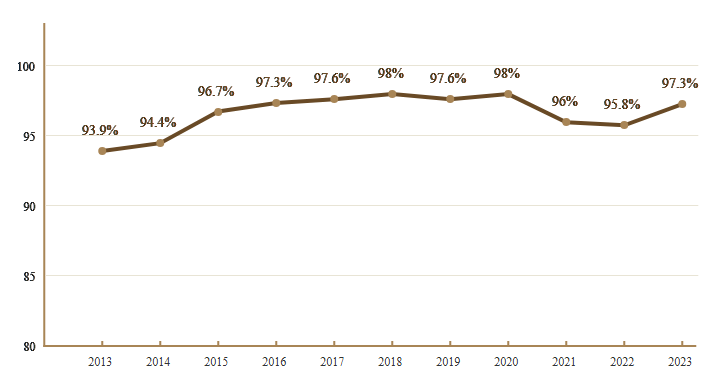
Figure 1: Average employment rate of Japanese university and college graduates in the past 10 years (Source: Ministry of Health, Labour and Welfare)
First Salary (Shoninkyu)
First salary or "Shoninkyu" means the first monthly salary recent graduates receive from their employer. The average amounts range from approximately 210,000 yen for university graduates and nearly 230,000 yen for graduate school graduates. Clerical/humanities courses are referred to as "Jimukei", while technical/science courses are referred to as "Gijutsukei".
| Category | University Graduates | Graduates from Graduate School | ||
|---|---|---|---|---|
| Business (Jimukei) | Technical (Gijutsukei) | Business (Jimukei) | Technical (Gijutsukei) | |
| First Monthly Salary | 211,094 yen | 233,806 yen | 215,365 yen | 239,965 yen |
Figure 2: Average amount of the first monthly salary in each academic qualification (Source: National Personnel Authority)
Average Salary by Age
Annual salaries in Japan generally grow steadily with seniority. The annual salary for men reaches a peak of 7,020,000 yen at the 55-59 age group, then gradually declines. For women, salaries level off after the 25-29 age group. This represents the general demographic trend in Japan where more women historically transition to part-time employment models following marriage and childbirth.
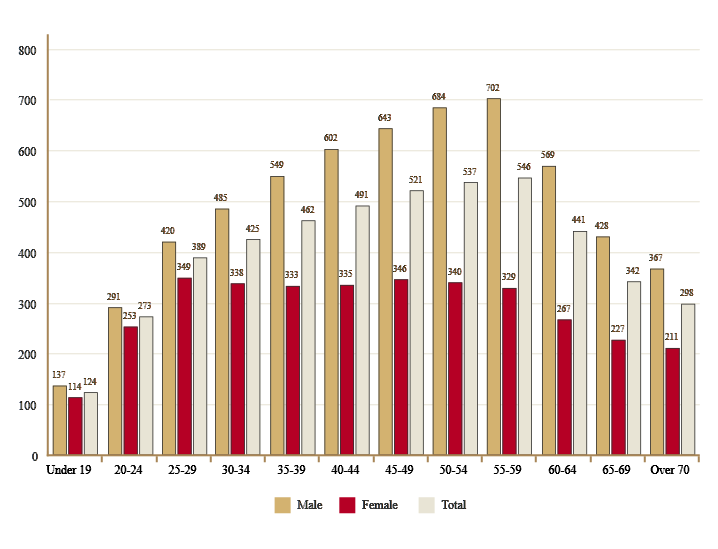
Figure 3: Average salary of private companies by age groups and sex (Source: National Tax Agency)
Job Situation for International Students
Number of International Students Employed
The number of international students in Japan reached about 310,000 as of 2019, more than double the number 10 years ago. Consequently, the number of international students seeking employment in Japan has nearly quadrupled over the past 10 years from 8,584 in 2011 to 33,415 in 2022. However, finding a job in Japan as an international student remains highly competitive and requires early, structured preparation.
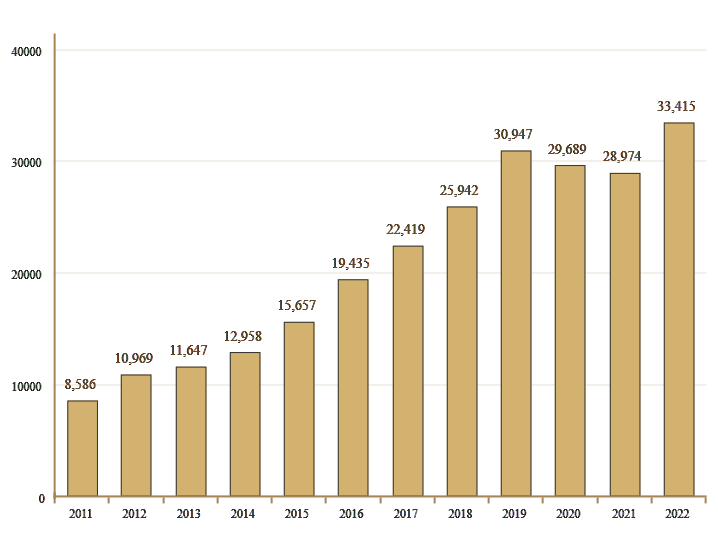
Figure 4: Number of international students graduating and working (Source: Immigration Bureau, Ministry of Justice)
Size of Employer for International Students
Approximately 10.1% of international students are employed by large corporations with 2,000 or more employees. Most students' initial jobs after graduation are at small and medium enterprises (SMEs) with fewer than 50 employees.
Japanese SMEs do not only play the role of subcontractors. Many successful smaller companies hold the world's highest-ranking technologies or the number one market share in specific niches. Broadening your research to include smaller companies can significantly increase your employment opportunities. Additionally, starting paychecks between large corporations and SMEs are very similar, both hovering around 200,000 yen.
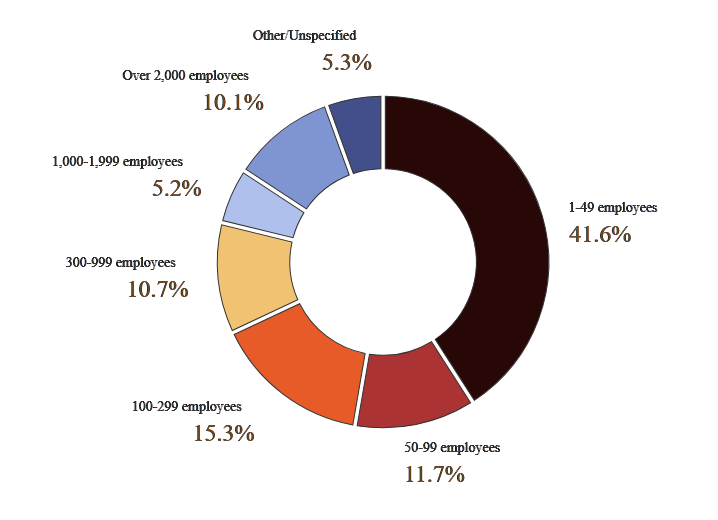
Figure 5: Scale of employees in companies employing international students (Source: Immigration Bureau, Ministry of Justice)
Industries Employing International Students
Just under 15.2% of international students start their careers with manufacturing companies, while 84.4% choose non-manufacturing sectors. Wholesale and retail trade sectors are the most common pathways, followed by academic research/professional services, information/communications, and lodging.
Figure 6: Industries of employment (Source: Immigration Bureau, Ministry of Justice)
Comprehensive Guide Chapters
Employment Environment in Japan
Understand corporate hiring trends and expectations for international students.
Job Hunting in Japan
Navigate the unique characteristics, applications, and entry sheets of Japanese job hunting.
Job Hunting Schedule
A timeline of pre-grad activities starting from your third university year.
Employment Examinations
Prepare for SPI aptitude tests, written exams, and multiple rounds of interviews.
Status of Residence
Legal requirements for changing your visa status from student to full-time work.
Job Hunting in Japan
Job hunting in Japan is very unique. You can hardly find a similar style of job hunting in any other country. Japanese companies recruit international students using the same quota and recruiting process as Japanese students. In other words, foreign students must compete with their Japanese counterparts for positions. In many cases, recruitment activities for foreign-affiliated companies in Japan are almost the same as those for Japanese companies. Therefore, in Japan, you must find a job under the domestic rules, regardless of whether you are applying to a Japanese or foreign-affiliated company.
Characteristics of Job Hunting in Japan
Bulk Hiring of Recent Graduates
The term "new graduate hiring" refers to hiring for people who have graduated from universities, graduate schools, or specialized training colleges and are starting work for the first time. This Japanese way of bulk hiring or "Shinsotsu-saiyo", is quite unique. Companies recruit students who anticipate graduating in the following years while they are still in school.
Starting Work in April
While September enrollment is the norm in many countries around the world, Japanese universities and specialized training colleges usually enroll in April and graduate in March. Therefore, in Japan, students who graduate in March will enter companies and start working on April 1, the first day of the following month.
Job Hunting Schedule
Many companies follow the same recruiting schedule. In addition, job hunting in Japan starts earlier than in many other countries. As of 2024, job hunting starts on March 1 every year by students who belong to the year prior to the final grade, including the third year of their bachelor's course, first year of their master's course, or second year of their PhD course respectively.
Recruitment Examinations
Many Japanese companies require students to take written exams in mathematics, Japanese, English, etc. They also often require a profile-sheet with a statement written in Japanese. For interviews, a minimum of three interviews of various types will be conducted at each company.
Hiring Criteria for Japanese Companies
Overseas and Japanese companies tend to hire their staff according to different hiring standards. Many overseas companies have introduced a "merit-based pay system" in which promotions and salary increases are based on a person's ability, work results, and performance, and they look for people who can make an immediate impact upon hiring. In such a selection process, the student's major at their university, as well as expertise and skills obtained during internships, etc. can make the difference between whether they are chosen for the position or not.
Meanwhile, as Japanese companies are accustomed to taking the time to provide employees with training necessary for their job, they tend to recruit promising students with good qualifications, who are likely to contribute to the company in the long-run. The chart below shows data based on employers' responses regarding key characteristics they look for when recruiting potential employees. Japanese companies regard characteristics such as potential communication ability, independence and cooperativeness as more important than academic scores, expertise in a certain field, and foreign language ability.
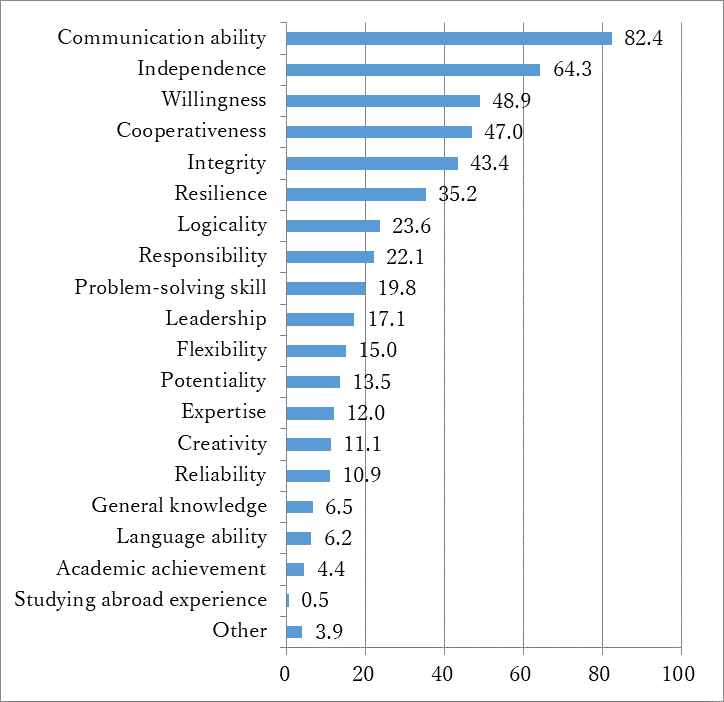
Figure 7: Key characteristics employers look for when recruiting potential employees (Source: Japan Business Federation)
Potentiality-hiring
"Potentiality" originally indicates a capacity for development and future success. "Potentiality-hiring" is a way of recruiting by attaching greater value to an applicant's potential capability and future possibility of being successful, even if they may not be qualified in terms of skills and knowledge to fully contribute to the company at that particular moment. Japanese companies tend to hire people who are expected to be active in the future, rather than people who can be immediately effective, because they have a solid training system in place after joining the company.
Employment System of Japanese Companies
Japanese companies mainly conform to membership-type employment. This kind of employment does not specify any job category, work place or working hours and requires employees to be flexible so that they can deal with various kinds of tasks. The main feature of the system is to evaluate the ability to handle all duties as a generalist.
These companies hire a number of employees through a unified recruiting campaign every year, then let them get a sense of the company as well as acquire necessary knowledge during the initial "on-the-job training" period along with various training sessions for employees to gain further knowledge and skills. Because the job category and place of work are not specified, a company can reassign an employee based on the company's circumstances. As a result, an employee may not be able to be placed in their position or location of choice. This kind of working style is recorded as "Sogo-shoku" or "main career track" on recruitment campaign documents.
Job-Type Employment (Global Comparison)
Among overseas countries, job-type employment is mainstream. Job-type employment is a form of employment in which the duties and work location are limited. It is characterized by clear job requirements and primarily evaluates the specialist's ability to perform the job. Continued employment and benefits depend on the duration of work and ability to perform. Companies can secure highly specialized and talented workers, but because they contract with workers within a specific job scope, if the job is no longer needed due to changes in the company's business conditions or policies, the contract may be terminated without reassignment, meaning the worker is at risk of losing their job.
Job Hunting Schedule
In Japan, students who are about to graduate are recruited in bulk and employment examinations are conducted while they are still in school. In addition, many companies use the same hiring schedule. Therefore, the timing for hiring is once a year, so if you miss the hiring season, it will be difficult to find a job.
Job hunting starts on March 1 every year by students who belong to the year prior to the final grade, including the third year of their bachelor's course, first year of their master's course, or second year of their PhD course respectively. The recruiting season comes to an end four months later in the middle of June. Job hunting in Japan is characterized by starting early and taking as long as four months. In addition, preparation is important for job hunting in Japan, and it is often necessary to prepare up to 5 months in advance.
Please conduct job hunting while checking when you will join the company to start working.
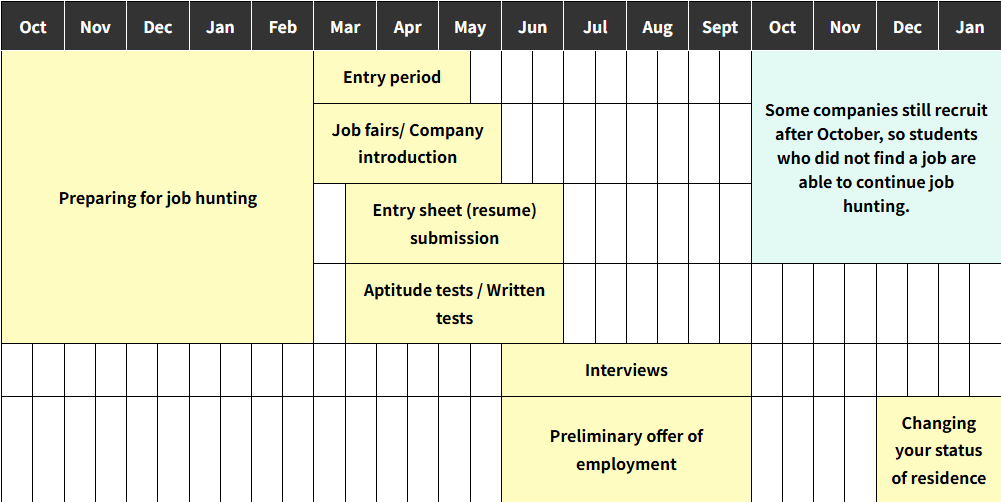
Figure 8: Annual Job Hunting Schedule and Milestones. Some companies still recruit after October, so students who did not find a job are able to continue job hunting. (∗ Note: The start date for September graduates may be April of the year following their graduation.)
Job Hunting Procedures and Exams
Entry Period (March through May)
Here, the word "entry" means requesting company materials and information. Upon entry, the company will send recruiting information, its company profile and the schedule of meetings by e-mail or postal mail. Entries can be made through employment information websites, company websites, and company introductions.
Job Fairs / Company Introductions (March through May)
Soon after the job hunting season has started, you will find many job fairs and company introduction opportunities. By attending these, you can obtain detailed information about companies by listening to explanations not published on their websites and by asking questions to hiring managers. Introductions can be organized solely by a single company, or as consolidated fairs with multiple companies.
Entry Sheet Submission (March through June)
Submission of an entry-sheet or an official application for an exam is the first step you must take in registering for a company's recruitment exam. Submission itself also means an official paper-based exam at the same time.
Aptitude Tests / Written Tests (March through June)
Aptitude tests and written examinations are conducted to ascertain whether students have reached a certain level of intellectual and academic ability, and whether they possess the thinking and judgment skills, work speed, processing ability, and accuracy required for the job. For companies with numerous applicants, these tests are used as efficient tools for selection.
Interviews (June or later)
It is common for a company to have three rounds of interviews. Companies conduct multiple interviews because they want staff members of various positions to check the applicant's personality and way of thinking in order to ascertain if they are really suitable for the company.
Preliminary Offers of Employment / "Naitei" (June or later)
After the final selection, you can get a "Nai-naitei", the first preliminary offer of employment which informs you of the company's intention to employ you. This tentative notice of acceptance often comes by phone. After the call, a notice of acceptance document will be sent. In the event that you have already received an offer from a different company or do not intend to work for the company, politely inform the company as soon as possible. In October, you will receive an official "Naitei", the official offer of employment.
Preparation for Job Hunting
Self-Analysis
Self-analysis means asking yourself again about your strengths and weaknesses, likes and dislikes, specialties and abilities, interests, future dreams, values, and outlook on life, and then organizing them. This preparation is done in order to find a job that you are suited for or want to do, and to present yourself well in entry sheets and interviews.
Research Industries and Companies
"Gyokai" refers to the categorization of industries by their activities. The first step to finding out whether a company is suitable for you is to do research on industries and companies. This research can help you discover a suitable company and industry and to clearly identify your goals in preparation for filling out your entry sheet and answering questions during job interviews.
Advice from Alumni
Prepare to visit alumni and acquaintances who work at companies you are interested in to gather information that you cannot find on websites. By asking questions you would normally be reluctant to ask in a company's official information session, you can obtain a deeper understanding about companies you would like to work for.
Entry Sheet and Interview Preparation
Making an entry-sheet is part of the overall recruitment procedure and also serves as practice for upcoming interviews.
Employment Examinations
Document-based exams, written examinations and interviews are often used as part of an employment exam. Preparations must be made prior to taking the examinations, and you must also review certain rules and manners beforehand. This chapter will provide you with information regarding the exams.
Document-based Examinations
Document-based exams make up the initial phase of job hunting activities. The entry sheet is one of these documents. By submitting an entry sheet, you make a formal application to take the employment exam. The entry sheet is very unique in the following points. One is the fact that companies are adopting different test formats. Another is short Japanese writing sections where you have to appeal what you did during your school life, why you would like to enter the company, and so on. Many foreign students who experienced job hunting activities in Japan often confess the entry sheet was the toughest task. In this section, you have to answer the company's provided questions with a set number of Japanese characters (around 200 to 400).
- Food Industry:"Describe your personality using a suitable food in 400 characters."
- Trading Company:"How will you contribute to this company after being accepted?"
- Machinery:"Describe why you would be indispensable to our company by referring to what you did your best during your school-life."
- Trading Company:"Describe what you have learned from your own experience of failure."
- Information/Communications:"If you had 300 million Japanese yen, what would you do to promote world peace?"
Writing in Japanese takes some time. In order to balance school research and other activities, prepare your essay early and gradually, and proofread it while consulting with your school's career support department.
Written Examinations
Written examinations are conducted to ascertain whether students have reached a certain level of intellectual and academic ability, and whether they possess the thinking and judgment skills, work speed, processing ability, and accuracy required for the job. When there are numerous applicants, these tests are used as efficient tools for selection. As paper exams are basically carried out in Japanese, applicants must have a high level of Japanese comprehension.
Though some companies offer original tests, most of them use ready-to-use exams developed by expert companies. Exams generally include an aptitude test, general knowledge test, and Japanese writing or short essay. Generally speaking, many companies adopt various aptitude tests. There are a variety of aptitude tests, but they include language-related questions in Japanese and English, as well as math-related questions. Although aptitude tests in Japanese and English or mathematics are not particularly difficult, time is limited. You have to train yourself in advance to answer many questions correctly in a short time.
Q1. Choose the phrase that uses the underlined word with the closest meaning:
Example: 無理がきく
Q2. Mathematics (Concentration):
There are 200 grams of water with a salt concentration of 3% and 300 grams of water with 4% concentration. How much will the concentration be after mixed?
Preparations for Written Examinations
- The first step is to find out what types of aptitude tests are used by the companies to which you are applying. As for big companies, you can find past exams from "Kaisha shikiho" (The Japan Company Handbook) or aptitude test preparation books. For smaller companies, you may find past records by checking graduates' reports at your school's career center.
- After obtaining information about your company's test, try to familiarize yourself with the patterns of aptitude tests and how to solve the problems. It is necessary to know and become familiar with the trends in the types of tests and the types of questions that will be asked. Practice with test preparation books sold at bookstores as well as questions you find online.
- Finally, try to get used to the time limit. What is difficult about an aptitude test is solving many questions in a short amount of time. As you have to solve questions efficiently, it is very important to always simulate the actual time span and get used to the limit even during a practice test.
Interviews
It is common for a company to have three rounds of interviews. Companies conduct multiple interviews because they want staff members of various positions to check the applicant's personality and way of thinking in order to ascertain if they are really suitable for the company. There are several types of job interviews in Japan. The three types commonly adopted by most companies include group discussions, group interviews, and individual interviews.
Group Discussions
Students are to discuss a given theme in groups of 4 to 6 people. Interviewers will evaluate the situation objectively. The purpose of this kind of interview is to check how an individual performs in a group.
Group Interviews
Carried out with many applicants to bring down the number of candidates so that individual interviews can be done. Characterized by a shorter time to respond and comparison with other candidates.
Individual Interviews
More time is spent with each individual to understand their characteristics. The interviewer checks not only your answers, but also demeanor, posture, facial expressions, and speech.
Train yourself to start with your conclusion, followed by certain episodes and a summary. You can record your speech and practice with a mobile phone. Check your eye contact, speaking mannerisms and what you talked about, then work on improving these points! It is also important to practice with your friends or staff at your school's career center, who can act as the interviewer during a simulation.
Gathering Information about Job Opportunities
Utilize diverse channels to discover job vacancies, understand schedules, and build connections with Japanese companies.
1. Employment Guidebooks: For information regarding the schedule for finding full-time employment, please refer to the following guidebook:
2. Utilize Employment Magazines: Utilize employment information magazines and specialized booklets to learn about various hiring initiatives, industries, and specific hiring events for international talent.
3. Utilize the Internet: Utilize not only information websites for the employment of international students but also mainstream information websites for Japanese students. More and more companies are posting job openings on their websites and accepting inquiries via email.
4. Participate in Job Fairs and Seminars: Many companies hold job fairs and seminars without specific selection at a venue. You will understand the companies by attending such fairs and seminars. Participate in them actively. Seminar information is published on each corporate website and job information websites.
Employment Service Center for Foreigners
From the viewpoint of enhancing international competitiveness, the Ministry of Health, Labour and Welfare is promoting the employment of international students in the professional and technical fields, including employment support to international students in Japan. Furthermore, the Ministry is providing a variety of job-finding information, career guidance starting from an early stage after admission, internship programs, and job interview meetings.
Main Contents of Support
- Employment guidance for international students
- Cooperation with universities (visit guidance)
- Internships for international students
- Implementation of job interview meetings for international students
- Career counseling and job placement for international students